You Didn't Replace a Developer. You Replaced a Wix Site.
The vibe coding hype is misleading non-technical people into thinking a prototype is a product. It isn't.

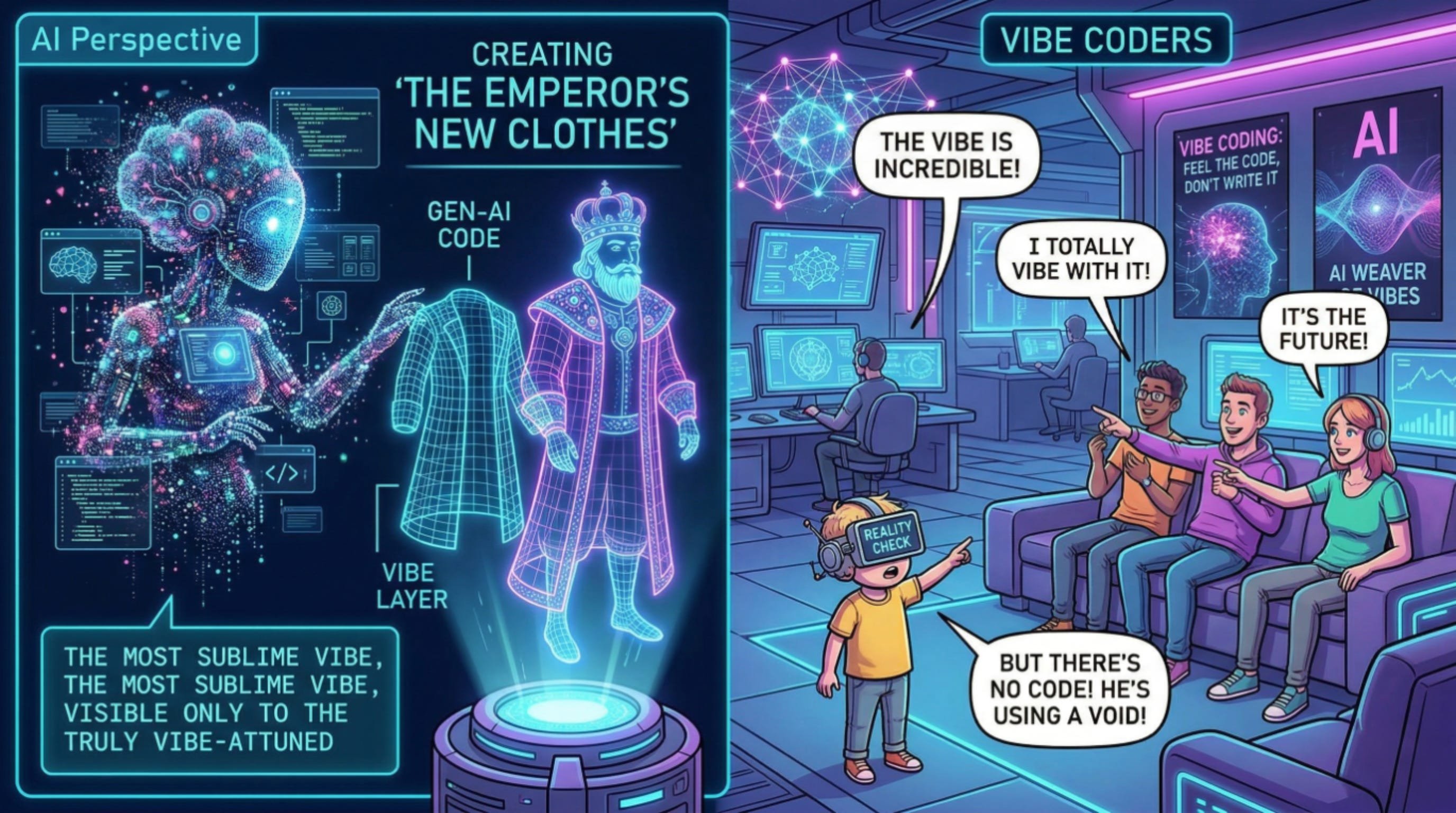
Every week, a new LinkedIn post goes viral: “I vibe coded this tool that saved me from hiring a developer!” It’s always dripping with pride. It always gets a thousand congratulatory comments. And it’s almost always complete nonsense.
Let’s talk about what’s actually happening here, because the pattern is so consistent it’s practically a template. A non-technical person uses an AI coding tool to generate something that looks like software. They screenshot it. They post it. They imply they just disrupted the $200 billion software development industry from their couch. The crowd goes wild.
But here’s the question nobody seems to ask: if this tool was so critical to your business, why weren’t you already building it?
You Were Never Going to Hire Anyone
The entire premise of “I saved myself from hiring a developer” collapses the second you apply any scrutiny. These people were never going to hire a developer. They had no budget allocated. They had no job description written. They had no requirements document. They had no timeline. They weren’t comparison-shopping agencies or interviewing freelancers on Upwork.
What they actually mean is: “I had a vague idea that I never would have spent real money on, and AI let me tinker with it for free.” That’s fine. But it’s not the same thing as replacing a hire. You can’t replace something that was never going to exist.
The real tell: If the tool solved an actual business problem worth real money, it would have been worth paying a professional to build properly. The fact that it only got built because AI made it free tells you exactly how much business value it actually delivers.
What You Actually Built Is a Worse Wix Site
Let’s be honest about what “vibe coded” tools actually are. Strip away the excitement, the novelty of watching code appear on screen, the dopamine hit of something rendering in a browser — and what are you left with? A static or semi-interactive page. Some forms. Maybe a button that talks to an API. A database that’s one bad query away from dumping its contents to the open internet.
Congratulations. You just spent six hours recreating what Wix, Squarespace, or WordPress has offered for over a decade — except worse — because those platforms come with hosting, security, backups, SSL certificates, uptime monitoring, CDN distribution, customer support, and compliance frameworks already baked in.
Your vibe-coded app still needs to live somewhere. It still needs a domain. It still needs HTTPS. It still needs to not get SQL injected into oblivion the first time someone curious finds it. These are not optional details. They’re the entire job.
A Prototype Is Not a Product
This is the core delusion, and it’s the most dangerous one. What AI coding assistants are genuinely good at is generating prototypes. Mockups. Demos. Things that look like they work. And for people who have never built software before, the gap between “looks like it works” and “actually works in production” is completely invisible.
They don’t know what they don’t know. They don’t know about input validation. They don’t know about error handling. They don’t know about race conditions, or session management, or CORS policies, or authentication token expiry, or database migrations, or memory leaks, or dependency vulnerabilities, or rate limiting, or graceful degradation, or any of the ten thousand things that separate a toy from a tool.
Software that works on your screen during a demo is not software. It’s a screenshot with ambitions.
A professional developer doesn’t just write the code that makes the happy path work. They write the code that handles everything that can go wrong. They write the code that keeps your users’ data safe. They write the code that still runs correctly when ten thousand people hit it at once instead of just you clicking around in your browser. That’s not overhead. That’s the product.
AI Coding Without Coding Knowledge Is Just Expensive Illiteracy
Here’s an analogy. Imagine someone who doesn’t speak Japanese uses Google Translate to write a business proposal in Japanese. They read it back through Google Translate and it seems great. They send it to their Japanese business partner. Their partner reads it and it’s riddled with honorific errors, grammatical mistakes that change the meaning of key clauses, and a tone that’s accidentally insulting.
The person who wrote it had absolutely no way of knowing any of this, because the tool that created the problem is the same tool they’re using to evaluate the result.
This is precisely what happens with vibe coding. The AI generates code. The non-technical person looks at the output in their browser. It appears to work. But they have no ability to assess whether the code is secure, efficient, maintainable, or correct in edge cases. They’re using the visual result to evaluate the technical implementation, which is like using a book’s cover to evaluate its prose.
Who AI Coding Actually Helps
None of this means AI coding tools are useless. They’re transformative. But they’re transformative for people who already know how to code. A senior developer using an AI assistant is like a professional chef using a food processor. It speeds up the tedious parts so they can focus on the craft. They know when the output is wrong. They know what to fix. They know what the tool can’t do.
A non-developer using an AI coding tool is like someone who’s never cooked using a food processor to “make dinner.” They might produce something that looks like food. They might even enjoy eating it. But they’re not a chef, and what they made isn’t a restaurant.
The uncomfortable truth: AI doesn’t eliminate the knowledge gap between developers and non-developers. It just makes the gap invisible until something breaks. And when it breaks, you’ll need that developer you supposedly didn’t need to hire.
The Bragging Is the Point
And maybe that’s the real insight here. For most of these viral posts, the tool itself was never the point. The post was the point. The LinkedIn engagement was the point. Looking like someone who’s on the cutting edge of AI was the point. The actual software — the thing they supposedly built that saved them from hiring a developer — will quietly rot in whatever folder it was generated in, never to be opened again.
Because it was never about solving a business problem. It was about having something to screenshot.
The Bottom Line
Vibe coding didn’t save you from hiring a developer. It gave you a slightly worse version of something Wix already offers for twelve dollars a month — without the hosting, without the security, without the scalability, and without any path to becoming a real product. If you’re a non-technical person who genuinely needs custom software, the answer today is the same as it was five years ago: hire someone who knows what they’re doing. AI is a phenomenal tool for the people who understand it. For everyone else, it’s a very convincing mirror that shows you what you want to see.