
Meta AI Made Every Facebook Post a Zero-Click Trap So Why Are You Still Posting There?
Your post is the prompt. Meta Has the answer. You are not the destination.

I scrolled past a post the other day that perfectly captured everything wrong with social media in 2026.

A page called BJJ Doc shared a video about Craig Kukuk — the first American to receive a Brazilian jiu-jitsu black belt from the Gracie family, then publicly expelled in the Gracie family newsletter shortly after. Classic engagement architecture: dangle the mystery, drive the click, capture the audience. Tap through and you would land on whatever site was monetizing the story.

Underneath the post, Meta AI had already done the work. A little suggestion chip read: “Why was Craig Kukuk expelled?”
Tap it, and Meta AI dumps a multi-paragraph answer right there inside the Facebook UI — the financial dispute with Rorion Gracie, the Torrance Academy compensation fight, the public disowning in the next Gracie newsletter, even the speculation about Renzo. Every piece of the story BJJ Doc was using as the hook. Delivered inside Facebook. The link to the underlying source dangling somewhere off-screen, irrelevant.
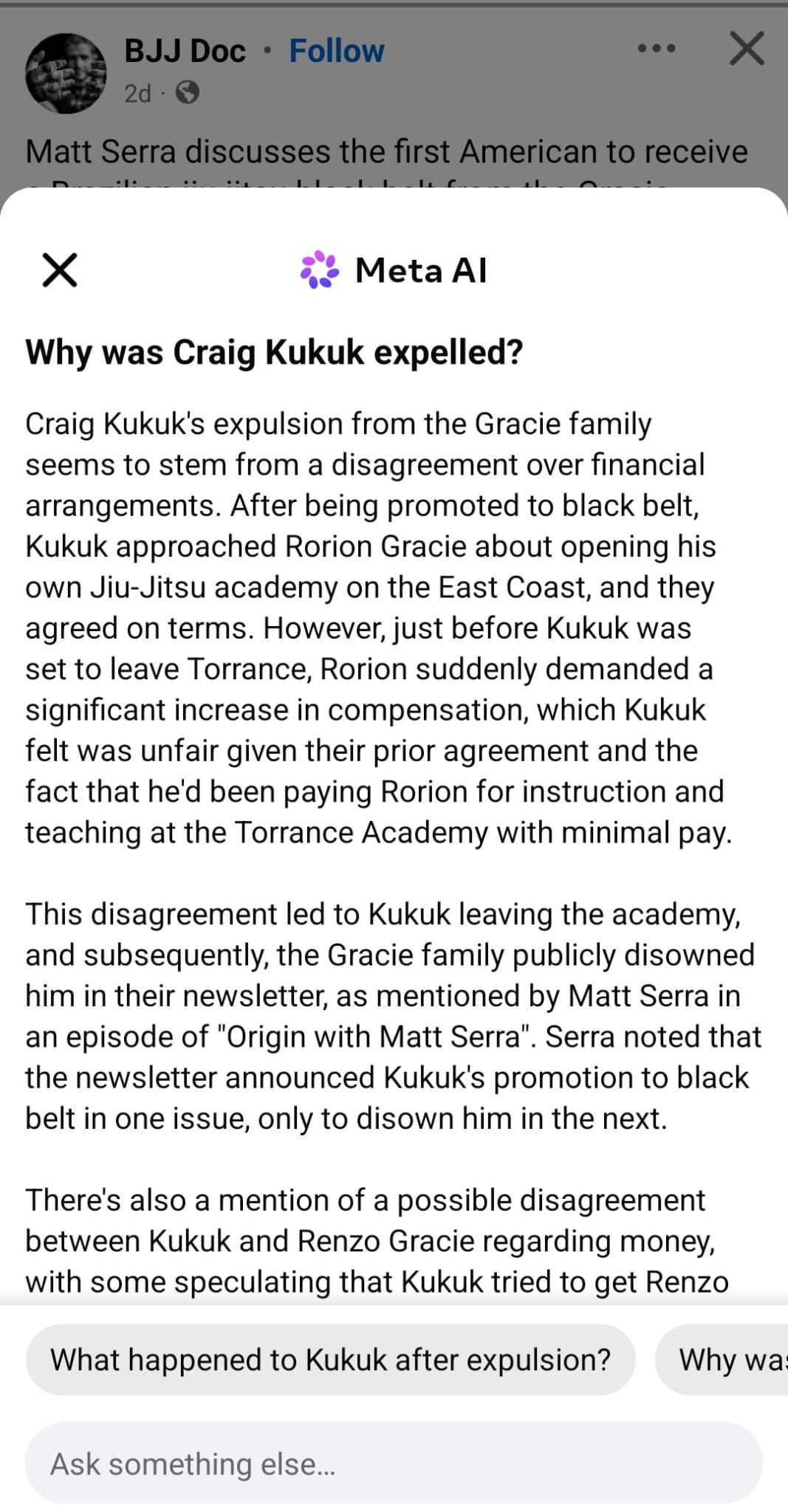
The publisher just got vaporized in real time. By Meta. On Meta’s own platform. While their post was generating the impressions Meta needed to keep the user there.
If this looks familiar, it should. We are watching Google’s AI Overviews — the same system that has gutted publisher traffic across the open web — get ported into the social feed.
The receipts on AI summarization are now embarrassing
This is not a vibes argument. The data on what AI summary boxes do to publisher traffic is now overwhelming.
A randomized field experiment from researchers at the Indian School of Business and Carnegie Mellon, posted to SSRN in April 2026, ran a clean A/B test: one group saw Google AI Overviews, another had them hidden in real time via a browser extension. The result was a 38% drop in outbound clicks on the queries where Overviews triggered, while the share of searches ending without any click jumped from 54% to 72%. User-reported satisfaction did not budge when the Overviews disappeared. Google is taking the click and giving nothing extra in return.
Other measurements pile on. Pew Research, working across 68,000 real queries, found click rates falling by roughly 47% when AI Overviews are present, and only about 1% of users click any link inside the Overview itself. Seer Interactive’s analysis of 25 million impressions clocked a 61% organic CTR collapse and a 68% paid CTR collapse on AIO queries. Ahrefs measured a 34.5% CTR drop for position-one rankings across 300,000 keywords. In Google’s full AI Mode, Semrush put the no-click rate at 93%.
This is not a forecast. It is a ledger. AI-summarized search means publishers eat the cost of producing the answer and the platform captures the value of delivering it.
Meta is now running the same play. Smaller container, same logic, and even less benefit to the person who actually wrote the content.
Facebook posting was already a bad trade. Now it is a worse one.
Meta’s relationship with publishers has been transactional and one-sided for over a decade. They told us video was the future, then defunded the video teams that pivoted. They told us the News Tab was the future, then killed it. They suppressed outbound links until Facebook and X were both feeds engineered to keep users inside the app rather than click through to publishers. Meta has even tested making businesses pay for the right to share more than two links a month.
Now Meta has completed the loop. Their AI does not just suppress your link — it reads the question your post implies, answers it inside the post itself, and uses your own content as training data to do so.
It is worth being honest about the new arrangement:
• The user gets the answer without leaving Meta’s app.
• Meta gets the engagement signal, the ad impression, and a fresh training pass.
• The poster — you — gets nothing. No click. No referral. No subscriber. Often not even a visible link.
Posting on Facebook used to mean: I make content, Meta shows it to a fraction of my audience, some of them click through. Reach was bad, but there was at least a reach.
That deal is gone. Facebook is no longer a distribution channel for your content. It is a content extraction surface that uses your post as raw material for the AI sitting on top of it. Every post you write is, functionally, a free prompt for Meta AI.
Meta is not a search engine. So why are you letting them crawl like one?
Here is the part most website owners have completely missed.
Google has a defensible reason to crawl your site: their search engine actually sends people there. Even with AI Overviews compressing CTR, Google still drives meaningful referral traffic to the open web. The trade is lopsided, but a trade exists.
Meta has no such argument.
Cloudflare’s data on AI crawler behavior is brutal for Meta. Their crawl-to-referral ratio sits around 73,000 to 1 — Meta pulls content at enormous scale and sends almost no traffic back. Meta-ExternalAgent generates roughly 52% of all AI crawler traffic on the internet, more than double Google and OpenAI combined. In Cloudflare’s Q1 2026 robots.txt analysis, Meta-ExternalAgent never appears in any allow rule — every other major AI bot shows up in both allow and disallow lists, but Meta’s is exclusively blocked or ignored.
Translation: when site owners actually look at this bot, none of them want it. Yet only about 2% of sites currently block Meta-ExternalAgent, compared to roughly 25% blocking GPTBot. The gap is not because Meta is the better partner. It is because most site owners do not realize Meta is in their logs at all.
And here is the kicker: Meta is not a search engine. There is no consumer-facing Meta product that returns ten blue links to your content. The crawler exists for exactly one purpose — scrape your work so the same AI assistant that just answered your readers’ questions inside a Facebook post can keep doing it. You are subsidizing the thing that is eating you.
Block them. Here is how.
There are two kinds of Meta crawlers, and the distinction matters:
• facebookexternalhit generates link previews when someone shares your URL on Facebook or Instagram. If you still receive meaningful referral traffic from organic shares, leave this one alone.
• meta-externalagent, Meta-ExternalAgent, Meta-ExternalFetcher, and FacebookBot are the AI training and answer-engine crawlers. These are the ones extracting your content for Meta AI summaries.
For most CTOs and site owners, the right move is to block the AI crawlers and keep the link-preview crawler. Drop this into your robots.txt:
# Block Meta AI training and answer-engine crawlers
User-agent: meta-externalagent
Disallow: /
User-agent: Meta-ExternalAgent
Disallow: /
User-agent: Meta-ExternalFetcher
Disallow: /
User-agent: FacebookBot
Disallow: /
# Keep link previews working
User-agent: facebookexternalhit
Allow: /
The caveat: robots.txt is an honor system. Compliance is voluntary, and the directives do not technically prevent any bot from accessing your content. Multiple webmasters have reported meta-externalagent continuing to crawl despite explicit blocks.
If you want enforcement rather than a polite request, do it at the edge. Cloudflare’s Block AI Scrapers and Crawlers toggle under Security → Bots covers Meta-ExternalAgent and the rest of the AI crawler set with a single switch. For ASP.NET shops running their own infrastructure, a piece of middleware that returns 403 on any request whose User-Agent header matches the Meta crawler set is a ten-minute job. For Nginx:
if ($http_user_agent ~* “(meta-externalagent|Meta-ExternalAgent|FacebookBot|Meta-ExternalFetcher)”) {
return 403;
}
Bonus move: alert in your WAF logs whenever any of these user agents still hit you after the block goes in. Meta’s compliance has been spotty enough that monitoring is worth the cron job.
What posting on Facebook is actually for now
I am not telling you to delete your page. Facebook still has 3 billion users. Local business, marketplace, community groups — there are still niches where the platform earns its place.
But if you are a publisher, a creator, or a CTO running content marketing for a product, your Facebook post is now a feature in someone else’s product. The post exists to give Meta AI a question to answer. You are the prompt. You are the training data. You are not the destination.
The right play in 2026 is the play that was already right in 2024 — it just was not urgent yet:
1. Own the audience. Newsletter, RSS, podcast feed, push notifications. Anything where the relationship is direct and the address book is yours.
2. Treat social as a teaser, not a channel. Post enough to maintain presence; do not write for the platform. Assume Meta AI will summarize anything you put on Facebook before a human reads it.
3. Block the crawlers that do not pay you back. Meta sends near-zero referrals. OpenAI and Anthropic at least sometimes cite. Google still drives meaningful traffic. Treat them differently.
4. Get cited, not just clicked. The half-truth buried in the AI Overview data: brands cited inside the Overview pull roughly 35% more organic clicks and 91% more paid clicks than uncited ones. If you cannot beat the summary, get inside it. That is the new SEO.
5. Diversify aggressively. Substack, YouTube, LinkedIn, owned site, real RSS. YouTube and Reddit together account for over 78% of AI social media citations. That is where the models read from. Be there.
The Craig Kukuk post will keep doing numbers — Meta needs the impressions. BJJ Doc will keep posting — Meta needs the content. And Meta AI will keep answering the question before anyone taps the link, because that is the entire point of the product.
Stop subsidizing it.
Gal Ratner is CTO of WhiteStar Labs and Prana Entertainment. He writes at galratner.com and BlogCloud.io.